
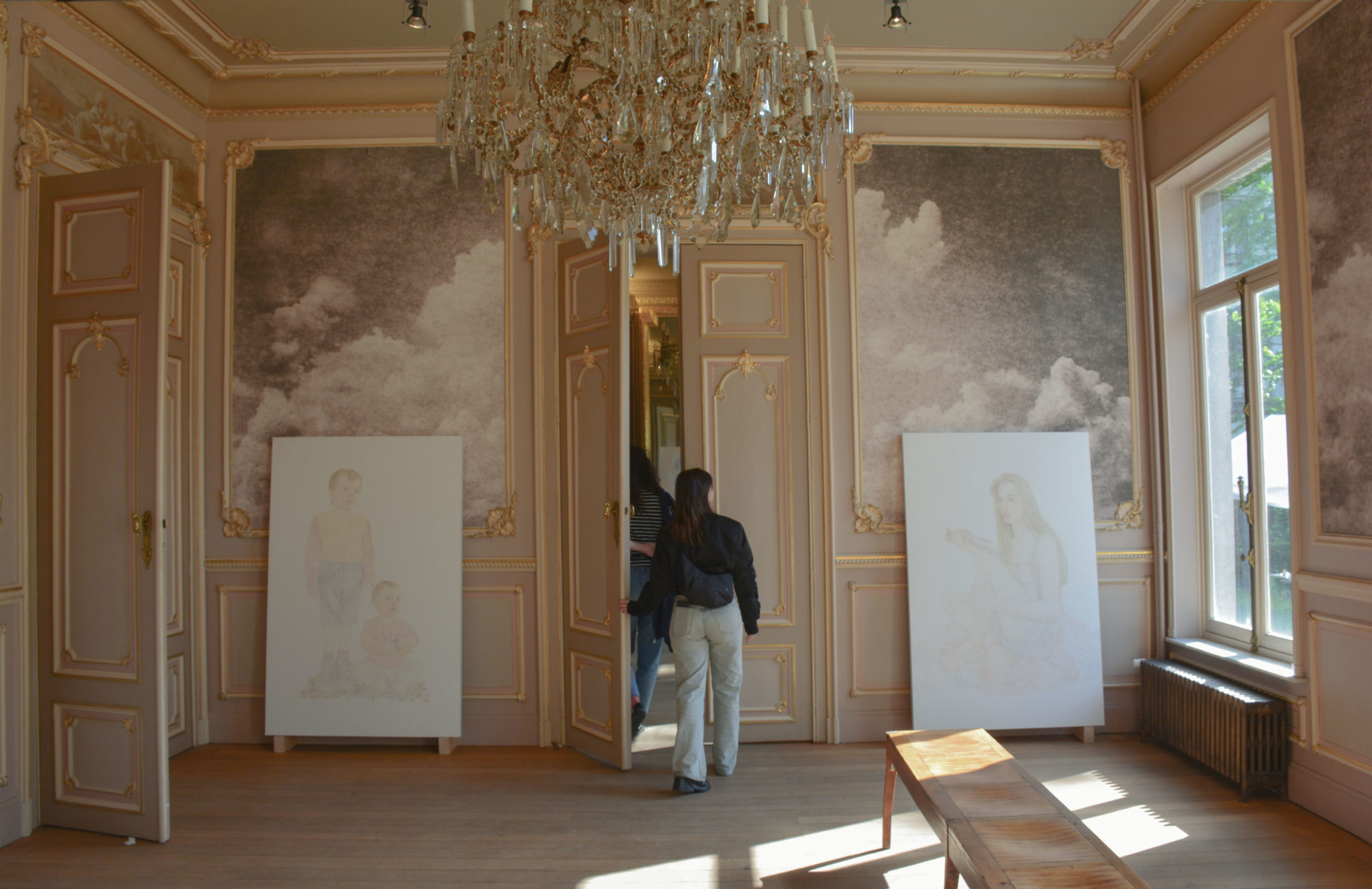
The House of Arts in Schaerbeek, Brussels, 2024
This analysis explores in depth the artistic work of Émilie Magnan, which focuses mainly on drawing. Since her beginnings, she has been attracted to the human body. Her work, often based on modeling and portraiture, has evolved towards formats approaching human size. Each stroke becomes for her a contemplation, a manifestation of respect and admiration for her models. When nudity is depicted, it is imbued with gentleness and dignity.
The gaze occupies a central place in her representations of the human body. She often accentuates the expression of the eyes, making them either stare directly at the viewer or ignore them. These gazes reveal a range of emotions, from astonishment to pride, evoking a deep and intimate languor. In the drawing Lau (2023, colored pencil on paper stretched on a frame, 165 × 110 cm), a young woman sits holding a dead bird, her gaze vacant. She seems to be staring at a distant horizon to her right.
The human figures she creates are sometimes self-sufficient, evolving in an immaterial place, a non-place, established by the presence of a vacant background, left to the sole action of the medium, the blank paper. This absence is not only visual, it is also auditory. In this silence, we may ask ourselves: what can’t we hear? Crying? Complaints? Angry shouts? Sniffles? This emptiness leaves room for questioning.
Some of his creations, in contrast to emptiness, are distinguished by a filling and an overload of elements, almost evoking collages. However, the main figure always remains in relief, emerging from the undulations of the pile. The surface covered with signs seems equivalent to the uniform white background. In the drawing Aurore (2022, colored pencil on paper stretched on a frame, 105 × 200 cm), a female figure stands out from the debris that surrounds her and covers the entire surface of the paper.
Her fascination with the figure of the doll is also evident in her work. She creates articulated figurines. The sculpture Poupée (2022, molded resin, 65 cm) is a self-portrait presented either assembled or in pieces, exploring the fragmented body and its implications. This attraction to dolls is reflected in her drawings through the hieratic postures of her models and spaces outside of any world, such as those of childhood.
In her drawings, the models appear aged, marked by time and experience. She depicts various stages of life, and children occupy an important place in her work. In the drawing Marie (2022, colored pencil on paper stretched on a frame, 200 × 105 cm), a young naked and wounded woman is surrounded by children covering the entire surface of the paper. This drawing questions motherhood and the future of younger generations.
The theme of injury is recurrent in his works, manifesting itself in various subtle forms such as bruises or scratches. These marks, although present, often seem to be ignored or accepted by his models. In the drawing Lisa (2023, colored pencil on paper stretched on a frame, 105 × 200 cm), a woman lying on her side with her back exposed has her head turned and is looking at the viewer. Her body is covered in bruises. However, despite her injuries, she seems to exude sensuality, even vitality. This adds a dimension of mystery and questioning to the works.
There are many symbols in her work, adding layers of meaning and context to the compositions. For example, in the drawing Auguste et Romane (2023, colored pencil on paper stretched on a frame, 165 × 110 cm), two toddlers stand side by side, their feet surrounded by dead insects. Their presence raises questions: are the children playing with the insects? Are they symptoms of something else? A narrative, suggestive, allusive dimension emerges in the drawing.
Her color palette is generally pale. The figures she draws seem ready to disappear, somewhat like in the Symbolist creations of the early twentieth century (particularly those of Fernand Khnopff). The colors are delicate and soft. In the drawing Isabelle and Marc (2024, colored pencil on paper stretched on a frame, 165 × 110 cm), a woman and a man sit close together. The overall tone of the drawing is very light, and the pastel shades blend delicately, giving an impression of softness.
Overall, her works evoke a restrained gentleness and suggest intimate narratives. Through her portraits, she explores themes such as motherhood, childhood, and human solidarity, capturing moments imbued with comfort and calm, though disruptive elements, such as the indecisiveness of location or the ambiguous play of gazes, thicken the potential reading of her drawings. Her group portraits highlight the solidarity and tenderness between the characters, while sensuality manifests itself on an individual level.